


Page 102 - BVA_2022
P. 102
Safety Instructions
Industry Safety Standards Hydraulic Pump Safety Instructions
Safety Instructions • READ AND UNDERSTAND ALL WARNINGS, INSTRUCTIONS AND OWNER’S MANUAL INFORMATION
BEFORE ATTEMPTING TO USE THIS EQUIPMENT
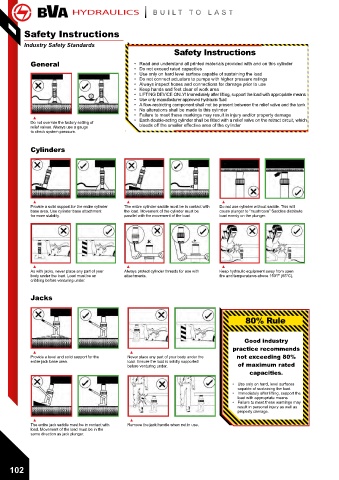
General • Read and understand all printed materials provided with and on this cylinder • Burst hazard exists if hose or connection pressure exceeds rated pressure.
• Do not exceed rated capacities • Do not exceed the rated capacity of this device. Monitor pressure and load at all times.
• Use only on hard level surface capable of sustaining the load • Verify load with calibrated load cell and indicator, accurate pressure gauge or equivalent devices.
• Do not connect actuators to pumps with higher pressure ratings • Inspect hoses and connections for damage prior to use. Never attempt to grasp a leaking pressurized hose.
• Always inspect hoses and connections for damage prior to use • Release the hydraulic pressure before disconnecting hoses or couplers, and before servicing the pump or accessory.
• Keep hands and feet clear of work area • Immediately after lifting, support the load with appropriate means. Never rely on hydraulic pressure to support a load.
• LIFTING DEVICE ONLY! Immediately after lifting, support the load with appropriate means • Wear protective clothing and eye protection that meets ANSI Z87.1 and OSHA standards when operating this equipment.
• Use only manufacturer approved hydraulic fluid • Ensure that the chosen application is stable to work on and around.
• A flow-restricting component shall not be present between the relief valve and the tank • Do not subject the pump and its components to shock loads.
• No alterations shall be made to this cylinder • Do not connect to applications which can return more oil to the reservoir than the pump reservoir can hold.
• Failure to meet these markings may result in injury and/or property damage • Ensure that the rated pressure of all applications and fittings is equal to or greater than the rated pressure of this pump.
▲ • Each double-acting cylinder shall be fitted with a relief valve on the retract circuit, which • Keep hydraulic equipment away from flames and heat.
Do not override the factory setting of bleeds off the smaller effective area of the cylinder • No alterations shall be made to this device.
relief valves. Always use a gauge • Failure to meet these warnings may result in personal injury as well as property damage.
to check system pressure.
Cylinders Pumps
Electric Pump
Safety Instructions
TO AVOID ELECTROCUTION HAZARD:
• Owner/Operator must read, understand and
follow all printed material provided with this
▲ ▲ ▲ ▲ ▲ device before use.
Provide a solid support for the entire cylinder The entire cylinder saddle must be in contact with Do not use cylinder without saddle. This will Do not use handle extender. Hand pumps should Close release valve finger tight. Using force will • Connect ONLY to properly grounded
base area. Use cylinder base attachment the load. Movement of the cylinder must be cause plunger to “mushroom” Saddles distribute be easy to operate when used correctly. damage the valve. electrical source. Connect to GFI outlet
for more stability. parallel with the movement of the load. load evenly on the plunger. ONLY! For use in dry locations.
• Avoid the use of extension cords. If used,
extension cord lengths up to 7 meter shall
be SJT-14X3 or heavier. For cords up to
15 meter, use SJT-12X3 or heavier.
• For extension cord lengths up to 30 meter,
use SJT-10X3 or heavier. NEVER use
a 3 prong adapter.
• Do not operate this device in an explosive
atmosphere or in the presence of
▲ ▲ ▲ ▲ ▲ conductive liquids.
As with jacks, never place any part of your Always protect cylinder threads for use with Keep hydraulic equipment away from open Fill pump only to recommended level. Fill only when Use only genuine BVA hydraulic oil. The wrong fluid
body under the load. Load must be on attachments. fire and temperatures above 150°F (65°C). connected cylinder is fully retracted. can destroy your seals and pump and will render
cribbing before venturing under. your warranty null and void.
Jacks Hoses and Couplers Cross-Referencing / Engineering
80% Rule
Good industry
practice recommends
▲ ▲ ▲ ▲ ▲
Provide a level and solid support for the Never place any part of your body under the not exceeding 80% Clean both coupler parts before connecting. Use Detach cylinder only when fully retracted or use Don’t lift hydraulic equipment by the hoses.
entire jack base area. load. Ensure the load is solidly supported dust caps when coupler parts are not connected. shut-off valves or safety valves to lock-in cylinder
before venturing under. of maximum rated pressure.
capacities.
• Use only on hard, level surfaces
capable of sustaining the load.
• Immediately after lifting, support the
load with appropriate means
• Failure to meet these warnings may
result in personal injury as well as
property damage.
▲ ▲ ▲ ▲
The entire jack saddle must be in contact with Remove the jack handle when not in use. Keep hoses away from the area Do not kink hoses. Bending radius
load. Movement of the load must be in the beneath loads. should be at least 4½". Do not drive
same direction as jack plunger. over or drop heavy objects on the
hoses.
103
102 103
102

